


Selin Berktas, a fourth-year international undergraduate student from Azerbaijan studying English Literature and International Relations at UBC, has been exploring what it means to live, write, and imagine across borders and boundaries.
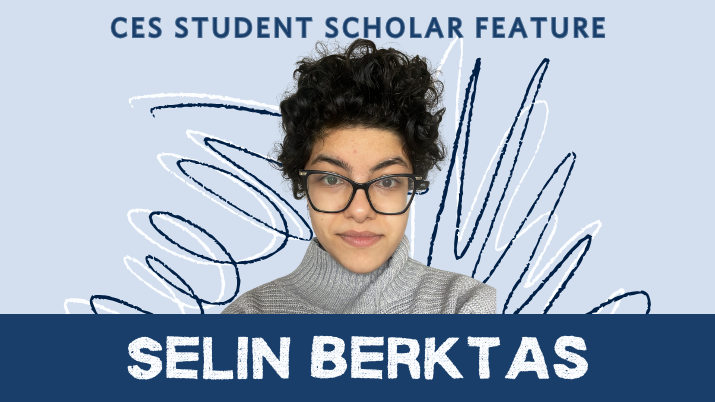
Her upcoming student-led seminar, Postcolonial Considerations of Literature from the Caucasus and Central Asia, was developed as part of her CES Undergraduate Research Fellowship, during which she examined the representations of the Caucasus in Russian literature. Berktas’ seminar course invites students to engage critically with how imperial legacies and borders shape identities and narratives in oft overlooked regions.
“I’ve always been interested in how borders are made and upheld,” Berktas explains. “Whether through literature or lived experience, there’s a continuity in how boundaries define belonging.” Berktas’ research explores depictions of Central Asians and Caucasians in Russian literature—a topic she found strikingly underrepresented. “There’s a big gap in discussion on the Caucasus region,” she notes. “We have courses on Russian and Eastern European literature, but voices from the Caucasus and Central Asia are often missing.”
Alongside her faculty mentor, CES Director Dr. Katherine Bowers, Berktas has envisioned and underscored how her seminar will center authors from within these decentralized regions, rather than those from the Russian canon. While Berktas notes that the syllabus is still in progress, she intends to include novels, short stories and other cultural texts from Kyrgyzstan, Georgia, Azerbaijan, Uzbekistan, Dagestan, and more, exploring how these works portray memory, and belonging while engaging with histories of empire and colonialism.
Berktas noted an important challenge when developing the seminar: access. Many regional texts remain untranslated or are only available in Russian. “It’s striking how difficult it is to find these works in English,” she says. “Some archives were lost entirely, like the burning of national libraries in Azerbaijan. That loss still shapes what we can study.” For Berktas, this imbalance underscores the ongoing need to decolonize literary studies—not just by revising syllabi but also by re-centering scholars and writers from the region itself.
“I want my research to serve my community rather than just be about it,” she reflects. “My goal is to bring what I’ve learned here back home—to help make space for conversations that start from within the Caucasus and Central Asia.”
Berktas’ student-led seminar takes place in 2025 WT2, Tuesdays and Thursdays from 4:00-5:30pm.


